I actually finished this book a few weeks ago. I had started reading In Memoriam by Alice Winn, which I have now gone back to, but was about to go away on holiday and felt that In Memoriam might, perhaps, not be a holiday read and picked up Babel by R.F. Kuang to read on holiday instead. I had thought about reading this book for a while as I listened to the audiobook of Yellowface by the same author and absolutely loved it. My husband had read Babel before and from what he told me about the book it sounded like it could have been written by a completely different author, and I was very curious to read the book.
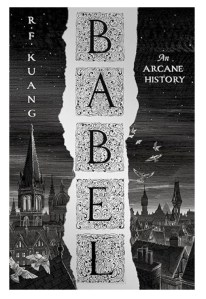
The blurb from the back of the book says:
“Oxford, 1836.
The city of dreaming spires.
It is the centre of all knowledge and progress in the world.
And at its heart is Babel, Oxford University’s prestigious Royal Institute of Translation.
The tower from which all the power of the Empire flows.
Orphaned in Canton and brought to England by a mysterious guardian, Robin Swift thought Babel a paradise.
Until it became a prison…
But can a student stand against an empire?
What is this book about?
Babel is a retelling of the mythical story of The Tower of Babel that was described in the book of Genesis in the Bible. In this mythical tale, all people spoke the same language, enabling them to live and work together. A grand city topped with a tower was built for the people to live in together with the Tower at the top of the city reaching towards the heavens.. The people thought that this Tower would bring them glory. And this tower was reaching up to the heavens. But God realised that with the people working together like this, then they could become immensely powerful, perhaps more powerful than God himself. And so, before the Tower could be completed, God made everyone speak different languages preventing them from understanding each other and scattered the people around the world. The Tower was never completed.
Babel, this book by R. F. Kuang is set in 1830s Britain. However, it is not exactly the 1830s Britain from our history, but rather an alternate universe. Much of the universe of this book is the same as our own, but in this universe silver-working has magical properties that run much of the world. Rather than the Industrial Revolution that led to much of today’s industrial progress changing the way that people lived their lives, and helping Britain to run their Empire, in Babel’s universe it was controlling silver-working and the resources required for silver-working (both physical resources and intellectual resources) that led to Britain’s dominance of the Empire here.
The main character in Babel is Robin Swift. A Cantonese boy orphaned in a plague, who is brought to England at a young age by a sponsor, Professor Lovell, a professor at Babel, Oxford University’s Royal Institute of Translation. Professor Lovell manages to arrive in the boy’s home just as his mother dies and with the boy’s life hanging in the balance. The boy is treated with silver and eventually makes a full recovery. He lives in Professor Lovell’s London home and is trained, groomed really, to be ready to enter Oxford University and take up the place Professor Lovell had decided he should have at the Royal Institute of Translation, which is located in Oxford’s Babel – a home not just for the study of languages, but its home of silver-working, where silver’s magical properties work with the space between the meanings of words and phrases as they are translated between different languages in a sort of alchemy producing effects. What are these effects? Things like, making transport work faster, more reliably and efficiently; making flowers grow more abundantly; generally making life easier, more efficient, reliable and beautiful for people. Well, certainly the people who are running the Empire.
When Robin enters Babel he meets three other students, Ramy from India, Victoire from Haiti, and Letty, an Englishwoman who are his first and only friends, and his cohort for that year’s entry to Babel. As the students continue their intense studies of language, and immerse themselves in this magical world they learn about silver-working. They learn how silver-working is achieved, and begin to understand the politics of the world they are now living in. For three of the students – Robin, Victoire and Ramy – they are very aware that their current privilege, and the students at Babel are given a lot of privileges that other students are not given, has been “given to them” by the institute and their benefactors. Each of these three students was taken from their less privileged lives in their home countries, groomed to enter Babel, and made very aware that they should be grateful for the opportunities given to them by their language skills. Life is different for Letty, who is an Englishwoman, already from a privileged background, but who had found herself gaining a place at Babel after her older brother died years earlier when a student at Oxford himself. Robin, who had lived a very lonely existence at Professor Lovell’s London home, falls in love with his new life at Babel, and with his friendship group who he sees more as family than just friends.
As the students learn more about the ethical and moral implications of their work – about who benefits from silver-working, who controls silver-working, how that control is obtained and maintained, and who pays the price of silver-working, Robin, along with Ramy and Victoire, starts to struggle with the tensions between enjoying the comfort and privilege of his new life, and the cost to other people of silver-working. He is asked to join negotiations in Canton for more resources and sees for himself the effect of obtaining and controlling these resources on local populations. The students start to question how silver-working is employed and whether there are better uses for it, uses that would benefit more people across the world, and whether knowledge and resources should be shared more.
There is a secret organisation working in and around Babel, Hermes, and Robin becomes involved with this secret society working against Babel and the absolute control it tries to maintain on its language and silver-working expertise, eventually involving all three students in this fight. As the novel progresses the fight over Babel’s influence increases and life is never the same again.
Would I recommend this book?
I started this review saying that I had previously read Yellowface by R F Kuang and that from my husband’s description of this book I wondered how it could have been written by the same author. Now there are a number of differences between the 2 books – Yellowface is a very American book, steeped in the world of publishing and in a modern day world very similar to our own. In Babel R.F. Kuang is clearly writing about an Oxford that she knows well (albeit making it an Oxford of this alternate, magical universe) and you would think that she was a British author. She is, in fact a Chinese-American author, and has studied at both Cambridge and Oxford Universities in the UK as well as Georgetown and Yale Universities in the USA.
But there are many similar themes running through the two books as well. Where Yellowface talks about the theft of ideas, and particularly of taking someone’s story and passing it off as your own, Babel talks more of the theft of resources and knowledge. Both books discuss the experience of Chinese people being exploited by the Western world, or western people – in Yellowface it is an American woman trying to pass off the work of her dead Chinese-American friend as her own; and in Babel, it is the British Empire exploiting the silver resources of Canton, and Robin Swift – who is even made to change his name from his Cantonese name, which we never learn – who is taken from his home in Canton and groomed to use his mother-tongue to help the Empire control their silver-working resources.
I have seen a couple of reviews of this book that have said that it was like reading two different books, and I would agree that it is definitely a book of two halves. One half maybe slower paced, talking a lot about language, about where language comes from, and how it is used; talking about the hoarding of language as well as other resources. The other half is much more pacey, more of a page turner I guess as the main action of the book gets under way. And there is quite a lot of action in it.
I enjoyed both halves of the book. The first part inspired me to want to go back to learning a language, and I picked up my Duolingo app for the first time in ages. I liked going along with Robin as he navigated his lonely life in London, and finding like minded friends as he gets to Oxford. I liked that the book was set in a realistic, but very different version of Oxford, the magical alternate universe that was created by Kuang. Then I got caught up in all of the action in the second half of the book. I did find it a page turner, and really wanted to know what happened next, how it all turned out.
This is a rather long book, at 560 pages, but it didn’t actually feel like a long book. I read this on the kindle version, but paperback is available from book retailers.
I really enjoyed Babel, as much as I really enjoyed Yellowface and I would definitely read other books by R. F. Kuang in the future. I would give Babel 4.5 stars out of 5, and it’s up there on my favourite reads of 2024 list.
 Coffee Break Books
4 responses to “Babel by Rebecca F Kuang”
Love this review! I adored Babel (and Yellowface), for the reasons you outline above and more. In particular I really enjoyed your interpretation of the themes of the book – I’d never thought of the comparison in terms of theft of ideas / knowledge but it’s a great parallel to draw.
Agree on this and Yellowface feeling like very different books too – if you ever get a chance to read The Poppy War trilogy by the same author they feel very distinct too in terms of genre (although closer to Babel than Yellowface).
LikeLike
Oooh, thanks for the recommendation! When I get through my TBR I’ll have a look for it (who am I kidding that I’ll ever get through the TBR and not just add to it….)
LikeLiked by 1 person
(Glances at teetering TBR list) I feel your pain! Lovely problem to have though 😂
LikeLiked by 1 person
Indeed it is!
LikeLike