
Twelve-year-old Bird Gardner lives a quiet existence with his loving but broken father, a former linguist who now shelves books in Harvard’s library. He knows not to ask too many questions, stand out too much, stray too far. For a decade, their lives have been governed by laws written to preserve ‘American culture’ in the wake of years of economic instability and violence. To keep the peace and restore prosperity, the authorities are now allowed to relocate children of dissidents, especially those of Asian origin, and libraries have been forced to remove books seen as unpatriotic – including the work of Bird’s mother, Margaret, a Chinese American poet who left the family when he was 9 years old.
Bird has grown up disavowing his mother and her poems; he doesn’t know her work or what happened to her, and he knows he shouldn’t wonder. But when he receives a mysterious letter containing only a cryptic drawing, he is drawn into a quest to find her. His journey will take him through the many folktales she poured into his head as a child, through the ranks of an underground network of librarians, into the lives of the children who have been taken, and finally to New York, where a new act of defiance may be the beginning of much-needed change.
Our Missing Hearts is an old story made new, of the ways supposedly civilised communities can turn a blind eye to the most searing injustice. It’s a story about the power – and limitations – of art to create change in the world, the lessons and legacies we pass onto our children, and how any of us can survive a broken world with our hearts intact.
Blurb from the inside sleeve of the hardcopy cover of this book
My goodness, this was a good book. I absolutely loved it and could not put it down. It is a page turner of a book that gets you thinking about the world you live in; about the power of stories, of Arts; about the capacity of humanity both to create marvellous things and to both to act upon fears planted in your head, and also to ignore awful acts carried out against other people. This book will stay with me for a while, and will sit on my “books to heartily recommend” list for some time.
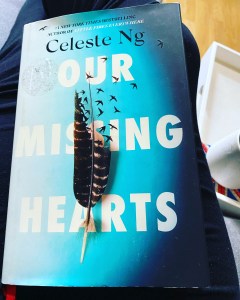
This is a book that is very much of its time. And in saying that I don’t mean that it is dated, far from it. But I read this in the summer of 2023 (yes it has taken me a long time to get round to writing this review up – the busy-ness of summer holidays with 2 young children at home are what I will blame….!), living in the UK. In the future, this book will still be relevant and will still be a very good book which I am sure will stand the test of time, but reading it now it feels incredibly, and uncomfortably close to reality. It is set in the USA, but here in the UK we are experiencing very high inflation, and a cost of living crisis, which is also being felt in many, many parts of the world. We hear every day about “Culture Wars”, about challenges to people’s rights to stage a protest, about crackdowns on certain activities in the name of protecting free speech. People are worried about being able to afford to live and many are looking for someone or something to blame for the situation they find themselves in. In many States in America books are being removed from school libraries in the name of protecting the children in those schools. Reading this book, it is quite scary to think how easy it would be for the USA, or another country including my own, to head down exactly the route that this book describes. I can imagine that the book is even more resonant for readers based in the USA. Perhaps if you are based there and are reading this review, you can tell me what you think?
The story is told from the perspective of a young boy living with just his father. He does not fully understand why his mother left him and his father, or why his father does not want to talk about his mother, why it seems that his father wants him to forget his mother. I think that having a young protagonist who needs everything explained to him – what the political situation is in his country, what his background is, how he and his family ended up in this situation, what happened to his mother – is a very good device for telling this story to the reader. We are in the dark about how the country ended up the way it is in the same way as Bird is.
One of the themes that the book discusses is the use of art, literature, poetry in protest. There is a long tradition of artists of all kinds using their work to comment on the political situations in their countries – to talk about or highlight injustices that people face. A song, or a book or a poem can have far more impact, it can stay with a reader or listener far longer, than a speech by a politician, or news commentary for example. Sometimes something an artist has written or made that was not written explicitly about injustice, or about a particular political situation, can resonate and be chosen as a kind of anthem for a movement. We have seen that in real life many, many times. And that happens in this book, where a poem written by Bird’s mother becomes an anthem for a movement that springs up in response to fictional American laws and culture aimed at protecting “American Culture”, even though she did not write the poem for this purpose. Bird’s mother has to leave her family in order to protect them after she and her family are targeted for her perceived attack on American Culture. This happens all the time, not just by people who would be seen as being subversive, but also when, for example, a politician chooses a song to accompany them on stage for a big speech or campaign rally. The artist involved does not necessarily give permission, or even know that their song is being chosen as that politician’s theme song, being associated with whatever that campaigner or politician is saying, but the song is nevertheless associated with the campaigner or politician, whoever is using that song. Is it fair for this to happen to an artist, an author, a musician? Is it fair enough that their work gains “exposure” being used in this way? Once a poem or a book or a painting, or a song is released, how much does the author or composer or artist’s intentions for that work of art matter? Do they have to accept the consequences regardless. This book made me think about these questions as much as it made me think about what the end consequences of society’s discussion of Culture Wars may be.
The book is a page turner. I did not want to put it down. It is frightening and hopeful. You want to know what happens to Bird and to his family. Will things get better for them and everyone affected by PACT, the fictional Preserving American Culture and Traditions Act? Well, you will have to read the book and make up your own mind.
The book is 335 pages long in the hardback edition I read, and I found it quite quick and easy to read. I would give the book 4.5 out of 5 stars, and absolutely recommend it.
 Coffee Break Books
One response to “Our Missing Hearts by Celeste Ng”
Great review. Informative. I’m going to buy this book as a present. Also, interesting discussion. Censorship is like ivy on a tree. It grows until it kills the thing it clings to.
LikeLike