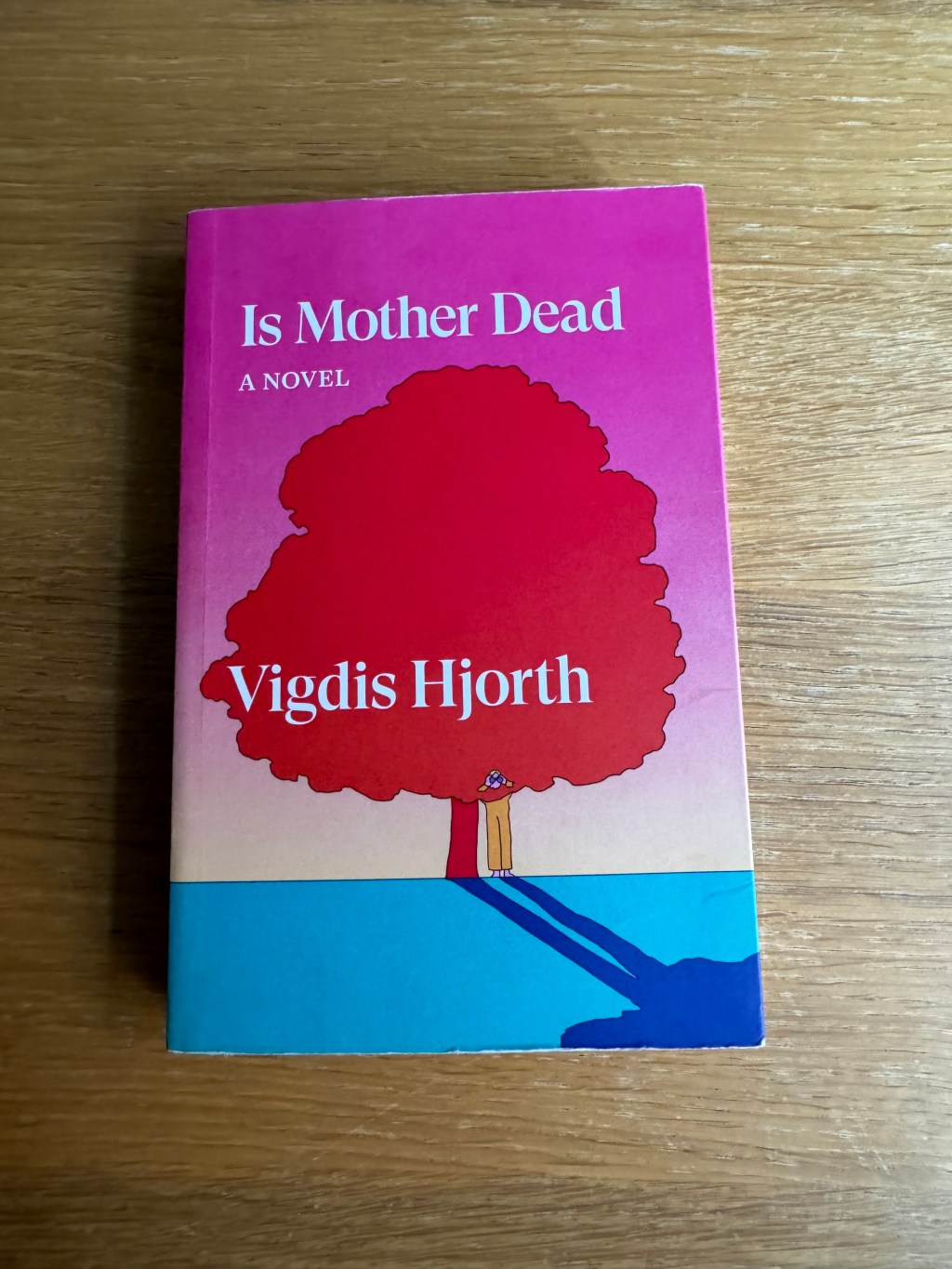
It has been a little while since I posted a book review. I have been reading, but just not got around to writing any actual book reviews. I will hopefully rectify that in the next couple of weeks. And I am going to start with this book that I was given for my birthday. A book that my children looked at, read the title with slightly worried glances, Is Mother Dead by Vigdis Hjorthis a very good book that I really enjoyed.
‘To mother is to murder, or close enough,’ thinks Johanna. A recently widowed artist, returned to Norway after a long absence, she is preparing for a retrospective of her career. The subject of her work is motherhood, and her controversial paintings have opened a rift between Johanna and her own mother. Physical proximity sets both women on edge, and it is not long before the older woman is stalking Johanna’s thoughts, and she in turn stakes out her mother’s home. Spare and rhythmic prose immerses the reader in a tortured, fascinating interior world. Vigdis Hjorth is at her raw, reflective best in this literary exploration of a primal and prickly relationship.
Is Mother Dead by Vigdis Hjorth is the story of celebrated Norwegian artist Johanna. Johanna had been living in America for several decades with her husband Mark and son, John who was now an adult. After Mark’s death Johanna was invited to return to Norway for a retrospective exhibition of her life’s work and with Mark now gone and her son living abroad, she decides it is time to return.
But when Johanna left Norway, she also left her first husband, a man her parents approved of; her career as a lawyer, which her parents approved of; and her family behind. They did not approve of her choice of new husband or her choice of new career. And while they kept in touch occasionally, her son receiving birthday cards from his maternal grandparents, even their very sporadic contact with each other ended after some of Johanna’s paintings, Child and Mother 1 and 2, were exhibited in Norway.
Then her father died and Johanna’s mother and sister continued their no contact with Johanna. Johanna can only imagine her mother’s life now, her mother’s thoughts and feelings about her life without Johanna’s father and without Johanna.
Johanna tries to contact her mother when she returns, but her mother refuses to see or speak to her, often using Johanna’s sister Ruth as her spokesperson. And as the book continues Johanna finds her mind consumed more and more by thoughts of her mother, of difficult childhood memories, until Johanna finds herself outside her mother’s new home, almost stalking her and trying to force her mother to speak to her.
This is a novel about a difficult relationship between a mother and her daughter. About the importance of that particular relationship. There is a little exploration of her relationship with her sister, and a little about her son and her father, but it is about the female relationships in her life, overwhelmingly her mother. It is a book about grief – as the novel starts both Johanna and her mother have lost their husbands and are dealing with their grief over the loss of these men in their lives. But it is mostly about Johanna’s grief in losing her relationship with her mother, and in coming to terms with this loss and with her memories of what seems to have been a rather traumatic, controlled and difficult childhood.
Johanna talks about her responsibility for this relationship and her guilt over how her actions have affected her family – it is all her fault. She left the family in Norway, she left her first husband, she left her respectable career, she exhibited the works that caused her family so much pain. Her feelings of guilt are overwhelming at the start of the novel, and it is only as the book goes on that she starts to explore things that happened in her childhood to shape her, her life and the decisions she has made. We see Johanna working through her feelings throughout this book, attempting to bury her feelings and her relationship with her mother- digging up things from the past (on one occasion quite literally). Learning to let go.
The book explores the stories told about our lives (and childhoods), by our families and by us, and how they are constructed reality. Johanna spends a lot of time talking about what her mum must be like, what her mum and sister’s relationship must be like, what they must be doing right now, inventing conversations her mother and sister may be having. She thinks back to events in her childhood and realises her mum hid things from her or her father and sometimes lied to her father – her mother made Johanna out to have done things she didn’t, in her memory Johanna’s mother constructed Johanna’s reputation with the rest of her family, and must be doing the same now.
I really liked Vigdis Hjorth’s writing style in this book. It is written without chapters but all in short sections (making it a really easy book to read in short chunks, but also, for me, one that kept me wanting to go on to the next page), some just a sentence or 2. The book reads a bit like these are Johanna’s diary entries, her stream of consciousness. She returns to same thought or idea a few times every now and then, as if processing that thought. This is a book about mental health- both Johanna’s and her mother’s. These are both damaged women, damaged by their childhoods, and about the realisation for Johanna that her mother had own childhood struggles that she had to deal with and that shaped her as much as her own childhood struggles shaped Johanna. The book is about how Johanna comes to terms with this childhood damage both hers and her mother’s when she herself is a Mother and Grandmother. Johanna wonders if she has passed any of this trauma on to her child.
I really enjoyed this book. Although it was dealing with basically the whole of her relationship with her mother, it is showing you one slice of time in Johanna’s life. It is a book dealing with a character’s internal life, about her relationship with one of the most significant people in her life, and only really about this one relationship. I think this book will stay with me for a while and I will come back to thinking about this book from time to time. I will absolutely look out for more books by this author, and would definitely recommend the book. I would give this book 4.5 out of 5 stars, and would say that this is one of my favourite books of the year.
 Coffee Break Books