
I have been reading quite a lot recently. It is my children’s summer holidays, and they are still fairly young which means that I have less time to do my other work, but it does give me more time to sit down and read when I am not doing things with the children. I don’t know about you, but I go through phases where I read a lot and other phases where I don’t feel so much like reading. At the moment, i am definitely in a reading phase, so I plan to take advantage of it, and that means that I have a few book reviews to catch up on. Starting with this rather fantastic book, Strangers by Taichi Yamada.
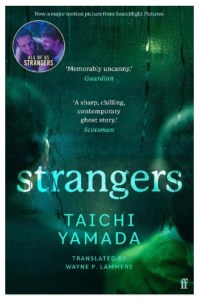
The blurb from the back of the book says:
Middle-aged, jaded and divorced, TV scriptwriter Harada returns one night to Asakusa, the dilapidated downtown district of Tokyo where he grew up. There, at the theatre, he meets a likeable man who looks exactly like his long-dead father. And so begins Harada’s ordeal as he’s thrust into a reality where his parents appear to be alive at the exact age they had been when they died.
What happens in the book?
When we first meet Harada, he is just divorced from his wife. He is estranged from his grown-up son, and struggling with all of his close relationships. These struggles appear to stem from having lost both of his parents when he was just 12 years old, and then being passed from one home to another as other relatives passed away. Harada is living in a large apartment block in a busy urban area, where the noise of the traffic outside never stops, but the inside of the apartment block is almost silent at night. This is an apartment block where most people use it for office accommodation as did Harada before his divorce. But there is one other resident, Kat, herself rather troubled after a bad accident that left her scarred. They strike up a relationship.
One night, after a colleague visited Harada to tell him they couldn’t work together any more as the colleague wished to pursue a relationship with his wife, Harada ends up going to visit his home town of Asakusa. There he visits a theatre and meets a man who looks uncannily like his father. His father takes him to his home and there is a woman who looks just like his mother. But they died when he was 12, so they couldn’t possibly actually be his parents, could they?
Harada visits the town and this couple several more times over the course of the story, and his relationship with Kat develops. But the visits seem to be taking a large toll on him and everyone, including Kat, is very worried about Harada and his health.
Would I recommend this book?
This is a ghostly story as well as a ghost story, right from the word go, with Harada describing the eerie silence of this building. A building meant to be full of life, but which empties after the working day.
It is a story about dealing with grief – Harada’s grief at losing his parents at a very young age; at losing his bond with his son, at the ending of his marriage, and even losing his relationship with his producer, Mamiya, and how he deals with that grief. Harada is at a crossroads in his life, where everything is changing for him and he is almost forced to deal with his feelings about losing his parents through the loss of his significant relationships with his wife and son. There is a physical toll as well as a mental one in dealing with this grief, and this is explored in this book.
I really enjoyed this book. I love Japanese writing generally, and will often pick up a book by a Japanese author. Here in this book, the ghost story is not overdone. It is not the sort of ghost story where a ghost turns up and immediately starts to terrorise the still living characters. Quite the opposite. But there re consequences to being involved with the ghosts, and these become clearer and clearer as the story progresses.
The story is really well paced, and easy to read. I wanted to keep turning the pages and find out what happened. There are lots of relatively short chapters, which is great for me. I have been reading this book during my young children’s summer holidays – we try to sit down together at 4.30 each day and have 30 minutes quiet reading time during the week, and I get my book out when they do so they see me reading as well as them, so it is good to be reading books that can be interrupted without losing the flow of what you are reading. And I have to say, having just read a few very long books, it was nice to get to read a book that wasn’t too long. At 201 pages, this was quite a short read really, but that in itself was a plus. It is nice to have some shorter books as well as the longer ones.
This book has now been made into a British film, called All of Us Strangers, with Andrew Scott, Jamie Bell and Claire Foy in. I haven’t seen the film, but would be very interested to see how they have done it, and how faithfully they stick to the book – particularly as you may have noticed from the cast I mentioned that they will have Westernised the film quite a lot I would imagine.
I thought the premise of Strangers was really interesting and really well written. So often with ideas like this, they start out very interesting and the story ends up being wrapped up maybe a bit too easily. I didn’t feel that way with this book. I really enjoyed it.
I would absolutely recommend this book, especially if you are a fan of Japanese writing. I would give the book 4.5 stars out of 5.
 Coffee Break Books