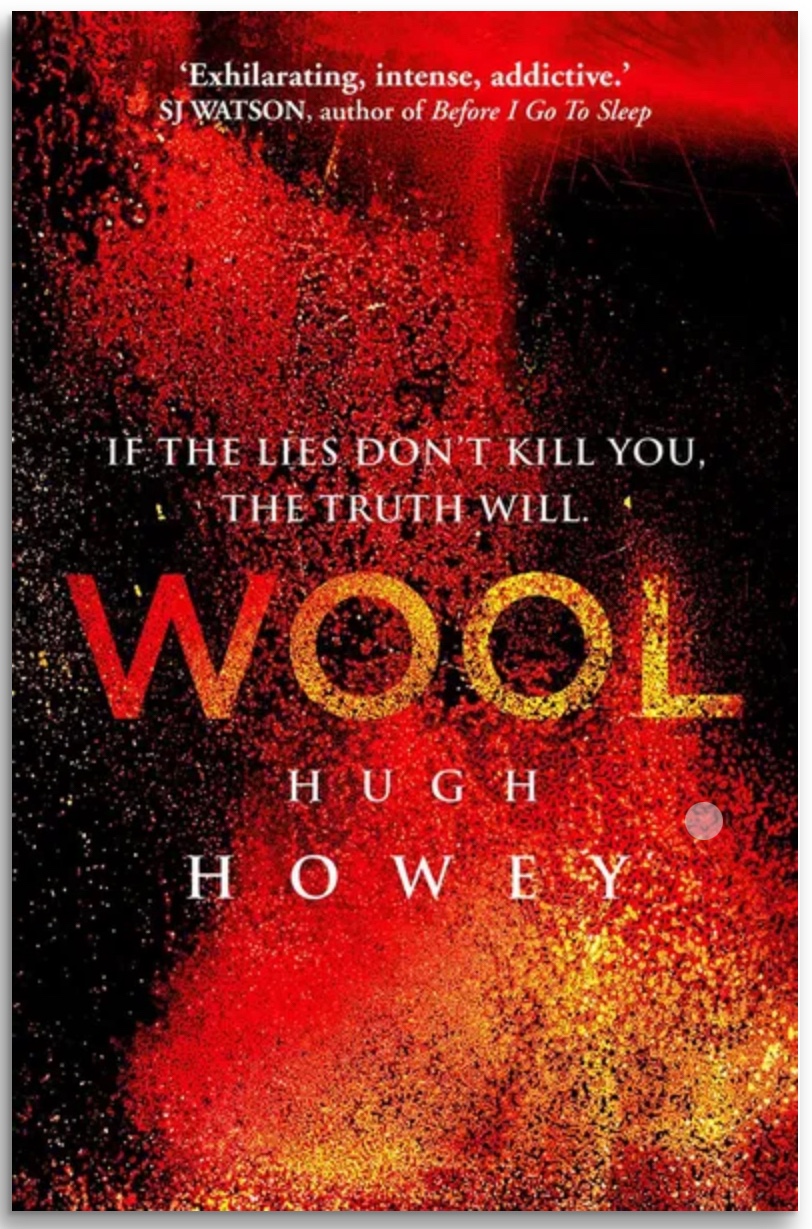
In a ruined and hostile landscape, in a future few have been unlucky enough to survive, a community exists in a giant underground silo.
Blurb for Wool by Hugh Howey
Inside, men and women live an enclosed life full of rules and regulations, of secrets and lies.
To live, you must follow the rules. But some don’t. These are the dangerous ones; these are the people who dare to hope and dream, and who infect others with their optimism.
Their punishment is simple and deadly. They are allowed outside.
Jules is one of these people. She may well be the last.
I used not to be a fan of science-fiction, and before I met my husband I would largely avoid any science fiction either in books or on screen. However, after being with a science-fiction fan for more than a decade, somehow most of what we watch on TV could be at least loosely classified as science-fiction and he has got me reading some as well. So, when the programme Silo started on Apple TV earlier in the year we avidly watched it – and I am very much looking forward to the next season. This first season ended on quite the cliffhanger, and when my husband told me that we actually had the book the show was based on, and not only back but the other 2 books in the trilogy I couldn’t resist reading it to find out what happened.
Wool, the name of the actual book that Silo was based on, tells the story of a group of people who live in a Silo. There has been some sort of ecological disaster which caused the Silo to be built, and while we don’t know much about what is going on in the world outside, we know that it is unsafe for anyone to go outside. The Silo has had residents in it for many, many years. We don’t know how many, and most, if not all, of the residents have only known life inside the Silo, deep underground where they are kept safe from the effects of the toxic air outside. And a whole town, really, has grown up in there complete with its own very strict hierarchy, judicial rules and punishments for not following those rules.
I mentioned the Silo’s hierarchy above. The Silo is very hierarchical with the people in charge of the running of the place living at the top of the Silo (compare this with The Upper Class). These people live closer to the surface, they have facilities like a large canteen with a big window onto the outside. The lower down the Silo you go, the jobs people have and the status they have changes until you go all the way down to the bottom of the Silo where the people in Mechanical live and work (the allegory with every class system in operation, including in my own country, UK, is absolutely not lost on me at all). The jobs people have within the Silo dictate the colour overalls they have to wear and this is the uniform for every resident. Their status on display for everyone to see.
The residents have never been outside the Silo, and in fact the most serious punishment for any crime is to be sent outside to “clean”, this includes for the crimes of questioning how things are run in the Silo, and even saying the words “I want to go outside”. This is where the title of the book comes from. To go outside a person will be fitted for their own suit, effectively a space suit, and taped into the suit. They will be given a square of wool and they will be asked to clean the cameras situated just outside the Silo’s doors. Everyone who has gone outside has cleaned the cameras, wiping off the dust that accumulates on the camera lens, and giving the residents a clearer picture of what lies just outside their Silo. No one lasts very long in that toxic air, so while this is a punishment for the person sent out to clean, it is also a warning to everyone else inside that it is just too dangerous out there, so they should just get on with life inside, and do as they are told to avoid being sent out there themselves.
This very hierarchical system run through fear and punishment, and which actively discourages people from asking questions about life in the Silo, almost asks for trouble to brew. And brew it does. The book follows what happens after one Sheriff asks to go out to clean and someone from Mechanical (right at the bottom of the Silo) is asked to take his place and move to the top of the Silo, where she starts asking a lot of questions.
I loved this book and found it very compelling. It is a very long book at 576 pages, but I found it an absolute page turner that was very difficult to put down. At the end of this book I wanted to get straight on to read the next one, and the next one. It is a plot driven book with, admittedly very little character development. When I finished the book, and before writing this review, I did have a look at what other people had said about it. Many reviews I read mentioned the lack of character development. This didn’t bother me at all, but I suspect that part of that was due to the fact that I had watched Apple TV’s adaptation before reading the book. The TV adaptation covers only the first half of Wool, and the characters there, and their back stories are very much fleshed out. The story of the woman from Mechanical moving to become the Sheriff plays out for a lot longer, and the people are far more developed. I do know that I pictured then characters from the TV adaptation in my head as I was reading the book, and I think had I not seen that first I would have been just as frustrated by the 2 dimensional characters here. Normally I would always say that you should read a book before seeing the TV adaptation, but I actually think that seeing the TV adaptation first made me much more invested in what happened in the book. Personally I would recommend approaching this book having watched season 1 of Silo before starting it, if you have the opportunity.
This is a plot driven, page-turner and an easy read. Notwithstanding the lack of character development, and with the caveat that you get a lot more out of the characters if you have been able to watch Silo on Apple TV first, I loved Wool. I couldn’t wait to read the next book in the trilogy, and so would give the book 4 out of 5 stars.
 Coffee Break Books